
Understanding Actinic Keratoses
Actinic keratoses are uneven, scaly patches on the skin caused by prolonged exposure to ultraviolet (UV) light from the sun or tanning beds.
These lesions commonly appear on sun-exposed areas — and are most frequently seen in fair-skinned adults over the age of 40.
Look out for:
Because these patches can be subtle at first, many patients don’t notice them until they become more pronounced or persistent.
Although small, actinic keratoses can progress to skin cancer if left untreated, so removal not only improves the look and texture of the skin but also helps protect your long-term skin health.
Here at Cryosonic, we specialise in Cryopen cryotherapy, a targeted, highly effective method for treating actinic keratoses.
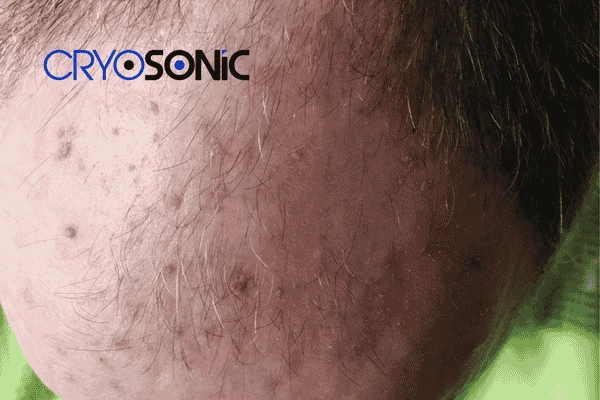
Our advanced Cryopen technology delivers a controlled spray of nitrous oxide to freeze and destroy abnormal skin cells precisely. This treatment is:
Cryopen allows many patients to start treatment on the same day as their consultation.
What is Cryosonic treatment?
Cryosonic Cryopen is a contemporary cryotherapy method that utilises a precise stream of nitrous oxide to freeze and eliminate actinic keratoses effectively.
How does Cryopen work for actinic keratoses?
Cryopen rapidly cools the abnormal cells, causing them to break down and be naturally shed by the body as the area heals.
Why choose Cryopen over traditional cryotherapy?
Cryopen offers greater accuracy and control than standard liquid nitrogen sprays, making it ideal for visible or sensitive areas, such as the face or hands.
Is Cryopen painful?
Most patients feel only a brief cold or stinging sensation during treatment, and anaesthesia is rarely needed.
How long does the treatment take?
Each lesion typically takes only a few seconds to treat, and most appointments are completed in just a few minutes, depending on how many patches you have.
Will I need more than one session?
Many actinic keratoses respond well to one treatment, but thicker or stubborn areas may benefit from an additional session.
Is Cryopen safe for facial lesions?
Yes — Cryopen’s precision makes it suitable for the face, ears and other delicate areas, with careful assessment to ensure the best outcome.
Can the lesion return after treatment?
Once actinic keratosis is treated, it generally does not recur. However, new lesions may form due to continued sun exposure. Be sun safe at all times.
What aftercare is needed?
After treatment:
Keep the treated area clean and dry
Avoid picking or scratching
Protect the area from sun exposure
Use a broad-spectrum sunscreen once healed
Your clinician will give you personalised care instructions for optimal healing.
Who is suitable for Cryopen treatment?
Cryopen is suitable for most adults with confirmed actinic keratoses. Your clinician will review your history and the appearance of the lesion to ensure this is the optimal treatment for you.
If you have noticed rough, persistent sun-damaged patches or are concerned about actinic keratoses, our team is here to help. Book your consultation today and discover how Cryosonic Cryopen treatment can safely and effectively restore your skin to a smoother, healthier state.